Register Of Holders
The register is empty. Whoever claims it first is written here for good — from $3.
The Story
On the morning of 21 December 1967, an archaeologist named Michael J. O'Kelly was sitting alone in the chamber inside a mound in the Boyne valley. He had been excavating the site for five years, and one thing had been bothering him: what was that odd narrow opening just above the door for?
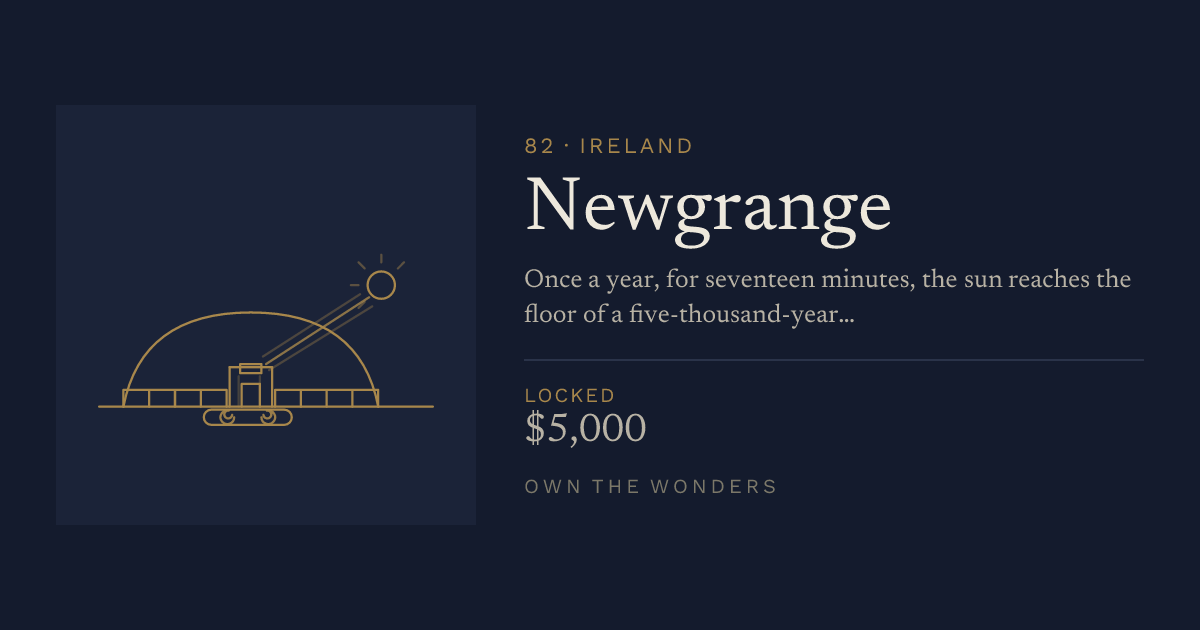
The light outside began to come up. Then, a few minutes after the sun cleared the ridge opposite, a thin band of light fell across the chamber floor. It widened, travelled into the room, stayed for about seventeen minutes, and withdrew. O'Kelly was the first person in modern times to sit and deliberately wait for it.
Older Than The Pyramids
Newgrange stands in eastern Ireland, in a fertile bend of the river Boyne. It dates to around 3200 BC — several centuries before the Giza pyramids and before the stone circle at Stonehenge. The people who built it farmed. They had no wheel and no metal tools.
The mound is eighty-five metres across and thirteen high: close to two hundred thousand tonnes of stone and earth. Ninety-seven large kerbstones ring its base. A passage nineteen metres long runs inside and opens into a cross-shaped chamber with three recesses.
The chamber roof is the most remarkable part. No mortar was used; the stones are laid so that each course oversails the one below, closed at the top by a single capstone. Each stone was set with a slight outward tilt, so rainwater soaking down runs off rather than into the room. That chamber has stayed dry for five thousand years.
Closed, And Forgotten
At some point the mouth of the passage closed and the mound slumped; from outside it was a hill under scrub. People are known to have come here in the Roman period — coins and ornaments were found deposited at the foot of the mound. Without knowing quite what it was, they understood it was a place that mattered.
In 1699 the landowner sent workmen up the hill to take stone for a wall. Pulling stones away, they found the mouth of the passage. For the next two hundred and fifty years Newgrange was an object of curiosity, and visitors carved their names into the walls.
Serious excavation began in 1962 and ran for thirteen years. That excavation also produced the view we see today: white quartz found in front of the mound was rebuilt as a steep facing wall, on the assumption that it had once covered the front. The reconstruction is still argued about; whether the quartz stood as a wall or lay spread on the ground is not settled.
The Hole Above The Door
What makes Newgrange particular is that narrow opening just above the entrance: the roof-box. A slot separate from the doorway, with its own lintel.
That separation says everything. If the point had simply been to let light in, the doorway would do. Making a second opening only makes sense if you want the light to enter while the door is shut. The passage also rises slightly from the entrance inward, so that the light of the low winter sun can run nineteen metres almost parallel to the floor and reach the chamber. On no other day of the year does the geometry hold.
Doing that means knowing which day is the shortest, measuring where on the horizon the sun rises on that day, and then setting two hundred thousand tonnes of material to that measurement. In a society without writing.
Today
Newgrange was inscribed on the UNESCO World Heritage list in 1993, together with the neighbouring mounds of the Boyne valley. Places in the chamber on solstice morning are allocated by a lottery held each year; tens of thousands of applications go in for around fifty places.
Visitor numbers are a threat in themselves. Moisture from breath is a new load on the stones of a room that has been dry for five millennia. Entry is limited and guided for that reason. What kept it dry was engineering; what keeps it dry now is a quota.
Sources & Further Reading
Institutional records for further reading; not a verification of every detail in the story.