92 · Libya
Leptis Magna
An emperor's hometown, a two-language dedication, and a harbour that made a city.
It opens once total volume on the register reaches $20,000.
Register Of Holders
The register is empty. Whoever claims it first is written here for good — from $3.
The Story
Find a place on the theatre steps and look through the columns towards the sea. Even without a performance, the building gives your body instructions: sit here, face that way, leave through the passage at the side. Ruins do not always communicate so directly. At Leptis Magna, the spaces between the stones can be as revealing as the stones themselves.
This is a city on the coast of modern Libya, near Al Khums, not a solitary monument preserved apart from its surroundings. The market, theatre, baths and harbour belonged to the same urban life. Their proximity lets you ask a more interesting question than which emperor built the largest structure: what did an ordinary day connect?
A City With More Than One Beginning
UNESCO traces the site's beginnings as a Phoenician trading port to the seventh century BCE. Its subsequent connections with Carthage and Rome changed the political setting around that harbour. They did not erase the place and start it again. Later architecture had to share space with earlier streets, buildings and habits.
That is why a single construction year would be misleading here. The surviving city contains several building campaigns. The Augustan market was already an established public space long before the Severan monumental centre took shape. Walking between them means moving through different generations of decisions about what this city needed and how it should present itself.
Read Below The Emperor's Name
The theatre dedication dates to CE 1–2. Augustus appears in its formal opening, but the person recorded as paying for construction is Annobal Rufus, a local notable. The inscription puts public generosity into durable stone. He also funded the market: the same name links places that served rather different needs.
There is another detail worth slowing down for. Below the theatre's Latin text are lines in Neo-Punic. Roman government and a Roman building type had not made the local language disappear. One dedication addressed readers through two written traditions. This is not evidence that every resident shared an identical identity; it is a surviving trace of a city speaking in more than one register.
Architecture For The Shopping Day
The market's two central pavilions are an unexpectedly elegant answer to an everyday requirement. Round cores sit inside octagonal arrangements of columns. Around them, the open court and surrounding porticoes organised a place for exchange. You do not need to imagine a particular merchant's conversation to recognise that this was architecture designed to accommodate people meeting repeatedly.
Its dedication, dated to 8 BCE in the inscription catalogue, names imperial authorities alongside local officeholders and the benefactor's family. A market can therefore tell you about more than goods. It preserves the language of civic status: who paid, who held office, and whose name would remain visible after the market day ended.
When A Local Man Became Emperor
Septimius Severus was born at Leptis Magna. During his reign, the city gained a monumental ensemble whose ambition is still apparent in its surviving fragments. The new forum and basilica, connected by an imposing urban setting, introduced a scale quite different from the older market. Imported marble became part of that transformation.
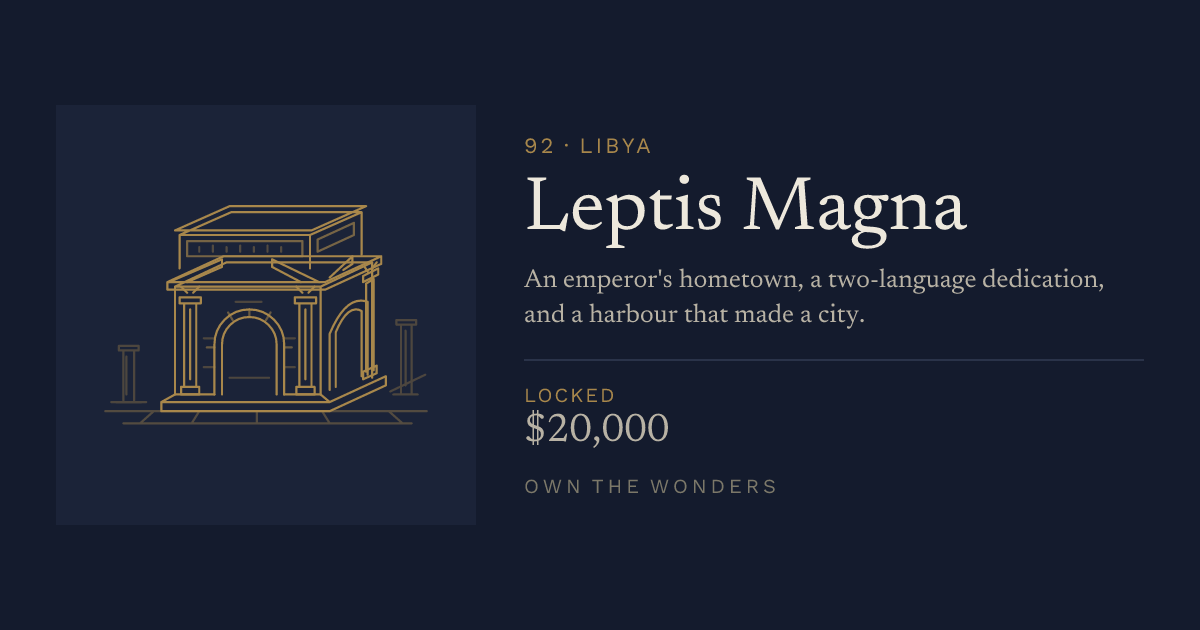
The arch associated with Severus is four-sided, standing at a street crossing rather than simply closing a city wall. Its projecting architectural elements and broken pediments make the surfaces unusually animated. The main illustration interprets this monument, not a generic Roman gate. Approaching from different streets would have changed how the monument revealed itself.
The Working Edge Of The City
The harbour helps explain how such ambition could belong on this coast. A basin, quays and works controlling the Wadi Lebda were parts of a connected infrastructure. Sea access was not just a fortunate geographical condition. It had to be maintained through construction and water management. The quay's changes of level remind us that buildings were also tools for moving between land and water.
Later centuries brought attacks, altered uses and contraction. Byzantine interventions gave parts of the city new functions; abandonment and drifting sand followed. Modern excavation made extensive remains legible again. Exposure, however, is not the end of an archaeological site's story. Once masonry is uncovered, keeping it standing becomes a continuing responsibility.
A Future Still Under Construction
Libya's Department of Antiquities manages the site. UNESCO's 2025 conservation decision calls particular attention to the Hunting Baths, tidal flooding and encroachment by the sea. Those concerns place the grand ruins back in the present. Leptis Magna survives through documentation, maintenance and difficult conservation choices, not through the permanence that stone seems to promise. The sea behind the theatre is a view; for the city as a whole, it has always been much more than that.
Sources & Further Reading
- UNESCO · Archaeological Site of Leptis Magna
- King's College London · IRT 319, Market
- King's College London · IRT 321, Theatre
- Open Yale Courses · Roman North Africa
- Oxford · Ginalis, Harbour construction, p. 34
- UNESCO · Conservation decision, 2025
Institutional records for further reading; not a verification of every detail in the story.
Where It Is
Archaeological Site of Leptis Magna, Al Khums, Libya
32.6383, 14.2931