Register Of Holders
The register is empty. Whoever claims it first is written here for good — from $3.
The Story
In the autumn of 1994, German archaeologist Klaus Schmidt was walking up a dry, dusty hill near Şanlıurfa. The locals called it "Göbekli Tepe"—the hill with a belly—and its only landmark was a single mulberry tree at the summit. Decades earlier, researchers from the universities of Chicago and Istanbul had surveyed the site but dismissed it as a medieval cemetery, assuming the limestone slabs poking through the soil were grave markers. Schmidt saw something else: the ground beneath his feet was covered in hundreds of thousands of worked flint tools and flakes. The hill was not a natural formation; it was a massive artificial mound accumulated over centuries. Schmidt realized that the limestone slabs were not grave markers, but the tops of prehistoric pillars buried deep within the earth.
When excavations began the following year, they sparked one of the greatest paradigm shifts in archaeological history. Rising from the dirt was a sanctuary built by people who did not yet know agriculture, settled life, pottery, or metalworking.
Temple Before City
The oldest enclosures at Göbeklitepe date to around 9600 BC, making them approximately 11,500 years old. This makes the site 6,000 years older than Stonehenge and 7,000 years older than the Great Pyramids. Until its discovery, the standard archaeological theory held that humans first invented agriculture, then built permanent settlements, and only after establishing towns did organized religion and monumental architecture emerge. Göbeklitepe reversed this sequence. Hunter-gatherers with no permanent villages gathered from far and wide to erect these massive structures. It was the shared belief system that drove them to settle down and domesticate wild crops to feed the builders, not the other way around.
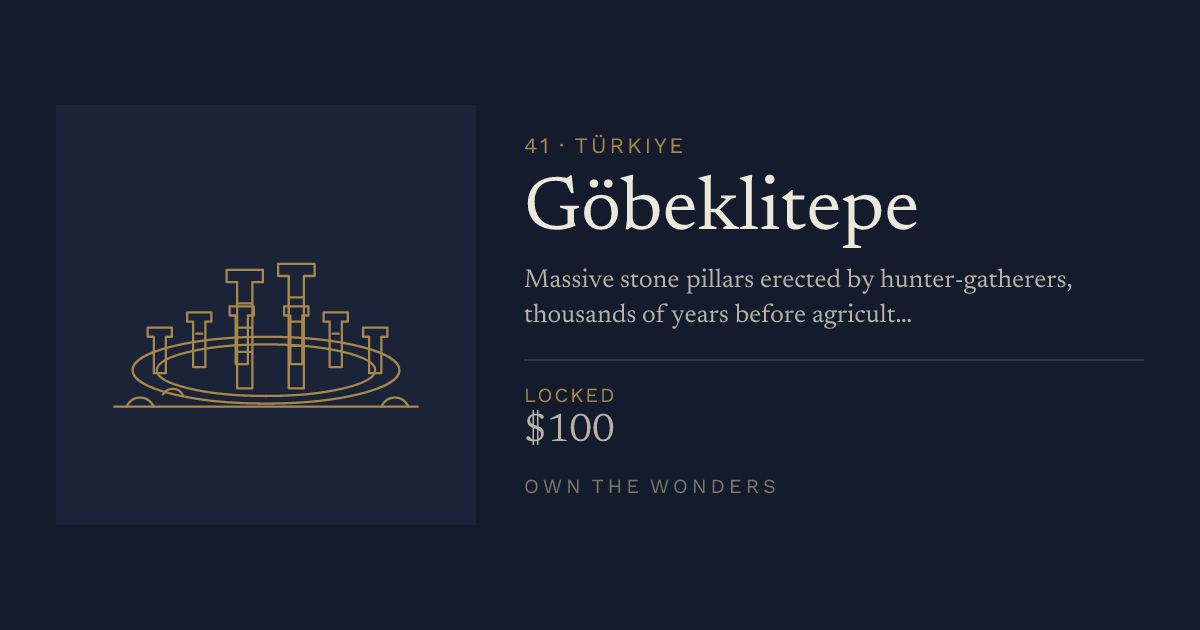
Building these structures required extraordinary cooperation and organization. Limestone pillars weighing between 10 and 20 tons were carved from nearby quarries using rudimentary flint tools and hauled up the hill by sheer human power. The enclosures were circular or oval, with a pair of central, taller T-pillars facing each other, surrounded by a ring of smaller pillars. These T-shaped stones were stylized representations of the human form: the horizontal top bar represented the head, while the vertical shaft represented the torso. Looking closely at the sides, one can see carved arms and fingers reaching toward the front of the body. They wore carved belts and loincloths, but they had no faces; they were faceless, nameless giants.
Intentional Secrets
The pillars did not just bear human limbs. They were carved in relief with the wildlife the hunter-gatherers encountered daily. Foxes, wild boars, vultures, snakes, scorpions, and lions stood guard on the stone surfaces. How these ancient artists carved such hard limestone with nothing but flint tools remains a subject of great marvel.
Yet, the greatest mystery of Göbeklitepe is not how it was built, but how it was abandoned. As archaeologists dug deeper, they discovered that the structures had not been abandoned because of war or natural decay. Around 8000 BC, after centuries of use, the builders deliberately filled the enclosures with hundreds of tons of soil, gravel, and animal bones, completely burying them. It was a ritual deactivation, a careful burial of a sacred space. This intentional burial preserved the limestone carvings from weathering and erosion for ten millennia. Without it, the wind and rain would have turned these monuments back into dust long ago.
Now
Göbeklitepe is now jointly managed by the Şanlıurfa Museum and the German Archaeological Institute, and was inscribed as a UNESCO World Heritage site in 2018. To protect the site from exposure, a massive canopy made of steel and high-tech membrane was built over the main enclosures.
Today, the biggest threat is exposure to the elements. After spending 10,000 years in a stable, humid subterranean environment, the limestone began to decay upon contact with air and sunlight. Conservation teams constantly apply chemical consolidants to prevent the stone surfaces from crumbling. Göbeklitepe stands as a permanent reminder that our transition to settled civilization began not with a practical necessity, but with a shared dream carved into stone.
Sources & Further Reading
Institutional records for further reading; not a verification of every detail in the story.