Register Of Holders
The register is empty. Whoever claims it first is written here for good — from $3.
The Story
In 1937 an Italian occupation crew took one of the tall carved stones out of the field at Aksum, cut it into sections, loaded the sections onto trucks, and shipped them to Rome. The stone was twenty-four metres of solid granite and had been standing, or lying, in that field for roughly seventeen centuries. It was re-erected near Porta Capena in the Italian capital, where it stayed for most of the next seventy years.
Italy agreed to return it in 1947. Nothing much happened for decades. In 2002 lightning struck the stele in Rome and damaged the top, and the argument suddenly acquired a deadline. It flew home in three pieces in 2005, in one of the heaviest air cargo operations attempted to that point, and was raised again on its own ground in 2008. The equipment that lifted it back up was not, in the end, doing anything the original engineers had not already managed once.
Buildings That Are Not Buildings
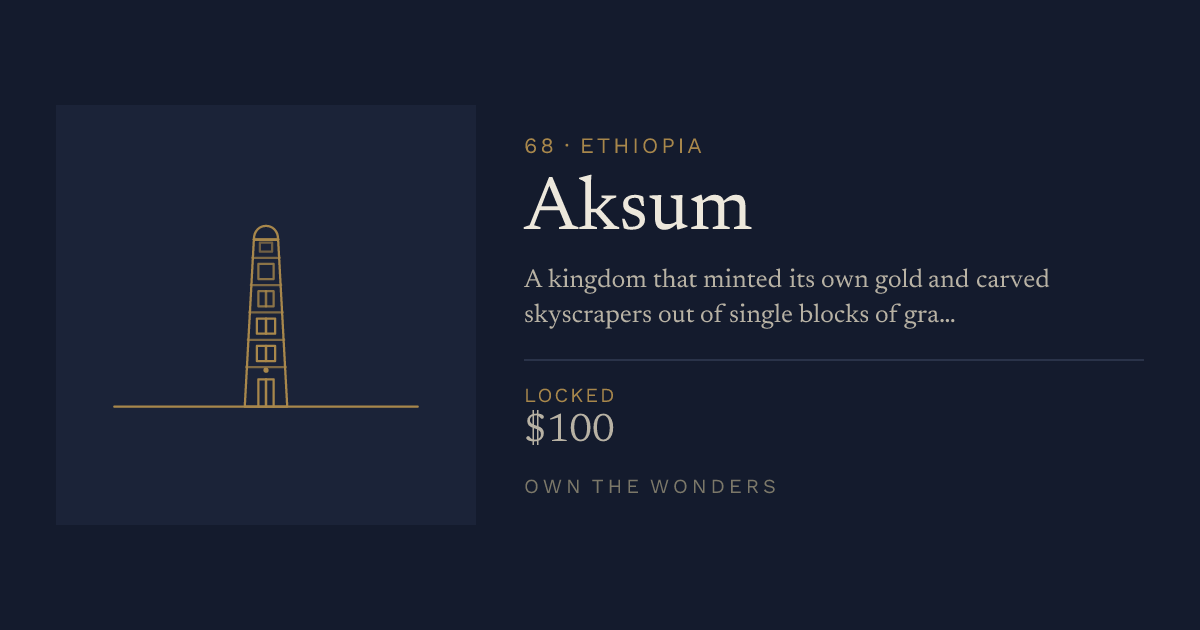
The stelae are the reason people come. They are single blocks of granite, quarried a few kilometres away, dressed and carved and stood upright over underground tombs. What is carved on them is the surface of a multi-storey building: rows of windows, round knobs imitating the ends of wooden roof beams, and at the bottom a false door complete with a lock and hinges. Nobody was meant to open that door. It is architecture rendered as sculpture, a tower that exists only as a picture of itself.
The largest one never worked. It is over thirty metres long, weighs several hundred tonnes, and lies broken in five pieces where it came down, most likely during the attempt to raise it or very soon after. It has not been moved since. An empire's most ambitious object is still sitting exactly at the moment it failed.
One Of Four Kingdoms
Aksum sat in the highlands of what is now northern Ethiopia, and its power came from a position rather than a territory: the Red Sea port of Adulis on one side and the caravan routes of the interior on the other. Ivory, gold, incense resins and aromatics moved through it toward Rome and India. A Greek merchants' handbook from the first century AD already names Adulis and names its king, which means the Mediterranean knew this place through its invoices before it knew it through its monuments.
In the third century the Persian teacher Mani listed the great kingdoms of the world and put Aksum alongside Rome, Persia and China. That is an outsider's ranking, not Aksum's own advertising.
Aksum struck its own coinage in gold, silver and bronze, something very few states of the period managed. It also used the coins as a message system: gold pieces meant for international circulation carried Greek, while the bronze meant for local markets carried Ge'ez. The mint chose an audience with every language.
In the fourth century King Ezana adopted Christianity, and the clearest surviving record of the switch is again on the money. The disc and crescent that had sat above the ruler's head disappear, and a cross takes their place. These are among the earliest coins anywhere to carry one. One of Ezana's inscribed stones says the same text three times over, in Ge'ez, in Sabaean script and in Greek, which tells you how many separate audiences a king here had to satisfy.
What Happened Next
The stelae stop after the conversion. Kings started building churches instead, and nobody ever again tried to stand up a three-hundred-tonne stone.
From the seventh century onward the balance of Red Sea trade shifted, Aksum's ports lost their weight, and the political centre of gravity moved south. The town shrank but was never abandoned, because it remained the ritual centre of the Ethiopian Orthodox Church. Tradition holds that the Ark of the Covenant is kept in a chapel beside the Church of Our Lady Mary of Zion, tended by a single monk who never leaves it. That is a matter of belief rather than of excavation, but it is the reason Aksum has never been a ruin that people merely visit.
Now
Aksum has been a UNESCO World Heritage Site since 1980. The stelae field, the royal tombs, the palace foundations and the church are all still there, and the unexcavated ground is far larger than the excavated ground.
The hardest years have been recent and not natural. Armed conflict in the region between 2020 and 2022 stopped excavation, scattered conservation staff, and made independent monitoring of the site impossible; access and maintenance have come back slowly since. The great fallen stele, meanwhile, is where it has always been. In seventeen hundred years, nobody has tried to lift it a second time.